
What the world’s healthiest people have always known, and why a patch of soil might be your best medicine!
There are places on this planet where people routinely live past 90, past 100, past ages that most of us have quietly accepted as unreachable.
Researchers call these places Blue Zones.
Sardinia in Italy. Okinawa in Japan. The Nicoya Peninsula in Costa Rica. Ikaria in Greece. And Loma Linda in California.
What makes these places remarkable is not some miracle supplement, some elite gym, or some morning routine that takes four hours and a personal trainer. What makes them remarkable is far more ordinary. And far more uncomfortable to accept.
The people living in these pockets of longevity are not doing anything flashy. They are walking to the market instead of driving. They are tending small plots of land instead of ordering everything from an app.
They are cooking their own meals, carrying their own groceries, sitting on their front steps watching the evening unfold. Their lives are, by modern standards, inconvenient. And that inconvenience is the whole point.
Longevity is not something you purchase. It is something you live. Slowly, consistently, with your hands in the dirt and your neighbors close by.
What they also do is move. Not in a gym, not on a schedule, but constantly and naturally throughout each day.
They bent down to pull weeds. They climbed hills because the hills were there. They carried baskets and chopped wood and kneaded bread. Their bodies were asked to work, and their bodies responded by staying capable far longer than we expect bodies to do today.
Blue Zone researchers call this “natural movement,” and it is one of the most powerful threads running through every long-lived community on earth. Not exercise as performance. Movement as participation in daily life.
In Okinawa, many elders grow a small personal garden well into their 80s and 90s. The practice is not just about food. It is about having a reason to get up and go outside every single morning, bend at the knees, use the hands, and be responsible for something living.

Your garden is not just a hobby.
Gardening has a quiet reputation. People think of it as something grandmothers do, a pleasant weekend distraction, a way to get a few tomatoes in August.
But when you look at the research and the lives of the world’s healthiest people, gardening starts to look less like a pastime and more like medicine.
Consider what actually happens when you tend a garden, even a small one on a balcony or a strip of raised beds in a backyard.
You are moving your body through a full range of motion. Squatting, reaching, lifting, carrying. You are spending time outside in natural light, which supports better sleep and a more stable mood.
You are in contact with soil microbes that researchers are increasingly linking to reduced inflammation and a healthier gut. You are eating fresher food. And you are doing something purposeful, something that requires you to show up regularly, think ahead, and care about what happens next.
That last piece matters more than most people realize. Purpose is one of the clearest predictors of longevity.
The Okinawans call it “ikigai,” a reason for being, something that pulls you out of bed in the morning with genuine interest. For many long-lived people, the garden is a daily expression of ikigai. It needs you. It rewards patience. It keeps you connected to the rhythm of seasons in a way that no screen can replicate.
A garden asks something of you every day. And in being asked, you stay a little more alive.

You do not need a farm.
One of the most persistent myths about gardening is that you need land. Real land, a big yard, a country plot, somewhere with space and sun and time.
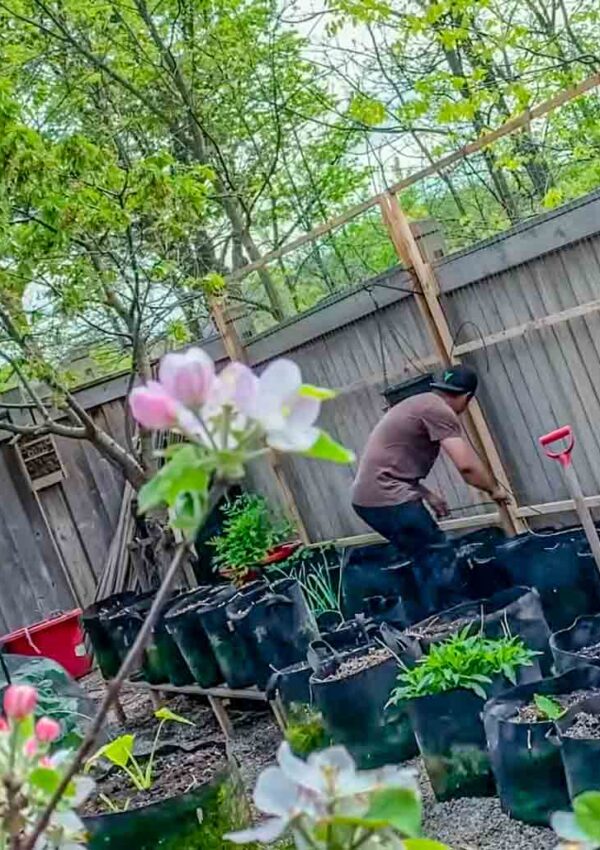
But the truth is that some of the most productive and life-giving gardens in the world are tiny. A window box of herbs. A single raised bed. A collection of containers on a sunny porch.
In Japan, where space is famously limited, people have grown vegetables on narrow balconies and rooftops for generations.
Small space gardening is not a compromise. In many ways, it is an advantage. A compact garden is easier to manage. It does not overwhelm you into giving up.
It fits into a life that already has plenty going on. You can grow lettuces in a pot, tomatoes up a trellis against a wall, beans in a deep container, herbs in a row on a kitchen windowsill.
You can grow enough to eat from regularly, enough to share with a neighbor, enough to feel the satisfaction of feeding yourself from something you grew yourself.
And that satisfaction matters. Research on what is sometimes called “the gardener’s high” shows that time spent in green spaces, especially time spent doing something productive in them, measurably reduces cortisol levels and lowers blood pressure.
Your nervous system quiets down. The background hum of modern anxiety softens. Even twenty minutes of digging or planting can shift your body into a different, calmer state.
If you are completely new to growing food, start with one container and one crop. Cherry tomatoes, bush beans, or a mix of salad greens are all forgiving, quick to reward, and easy to manage in a small space.
Give them good light, water them consistently, and pay attention. The habit will grow on its own from there.

The great irony of the longevity conversation is that we tend to look for the answer in the future, in the next supplement, the next biohack, the next thing to add to an already complicated routine.
But the communities living longest are not doing more. They are doing something simpler, and they have been doing it consistently for their entire lives.
They wake up with purpose. They move their bodies in the course of an ordinary day. They eat food that did not travel far or get processed much. They spend time outside.
They know the people around them and feel known in return. And many of them, in places as different as Sardinia and Okinawa and Costa Rica, grow at least some of what they eat.
You do not have to move to a Blue Zone. You do not have to overhaul everything at once. But you could, this week, put a pot of soil on your back step and plant something in it.
You could water it every morning and watch what happens. You could start small, stay curious, and let the practice ask something of you each day.
Longevity is not something you achieve through willpower alone. It is something that grows, slowly and steadily, out of the habits and connections and little daily acts that give your days their shape. A garden is one of the oldest ways we know to build exactly that kind of life.
Plant something. Tend it. Share the harvest. That is not just gardening. That is how people have lived well.